
How to measure correctly
Fingers change through the day, with the seasons and over a lifetime. A few simple things will get you to the right size from the start.
Time of day and temperature
- Fingers swell during the day and in warm weather.
- Preferably measure in the afternoon or evening, not early in the morning.
- Avoid measuring when you are cold or very warm.
The right finger
- The same finger on different hands can be a different size — the dominant hand is often slightly larger.
- Measure exactly the finger the ring is meant for.
How the ring should feel
- It should slide on easily, but meet a little resistance over the knuckle.
- It should sit securely without feeling tight.
- You should be able to rotate the ring, but it should not spin on its own.
The width of the ring matters
- Wide rings, from roughly 4–6 mm upwards, feel tighter. You often need to go up half a size.
- Slim rings usually fit well in the exact size.
Try several sizes
- Try two sizes, for example 17 and 17.5, and see how they feel after a while.
- Keep the ring on for a few minutes, make a fist and stretch out your fingers.
Body and everyday life
- Salty food, exercise, pregnancy and hormones can all affect finger size.
- Think about how your fingers usually feel in everyday life, not just at that moment.
Margin of safety
- If you are torn between two sizes: choose the smaller one. It is easier to make a ring larger than smaller.
Storlekstabell
Omkrets eller diameter?
O står för omkrets i mm och D för diameter i mm — samma storlek kan anges på båda sätten. Hos oss anges ringstorleken i diameter. En 17:a har alltså 17 mm innerdiameter och drygt 53 mm i omkrets.
| Storlek – diameter (D) | Omkrets (O) |
|---|---|
| 15 mm | 47,1 mm |
| 15,5 mm | 48,7 mm |
| 16 mm | 50,3 mm |
| 16,5 mm | 51,8 mm |
| 17 mm | 53,4 mm |
| 17,5 mm | 55,0 mm |
| 18 mm | 56,5 mm |
| 18,5 mm | 58,1 mm |
| 19 mm | 59,7 mm |
Storlek 15–19 i halvsteg finns i webbshoppen. Behöver du en annan storlek gör vi den på beställning — hör av dig så löser vi det.
Try at home
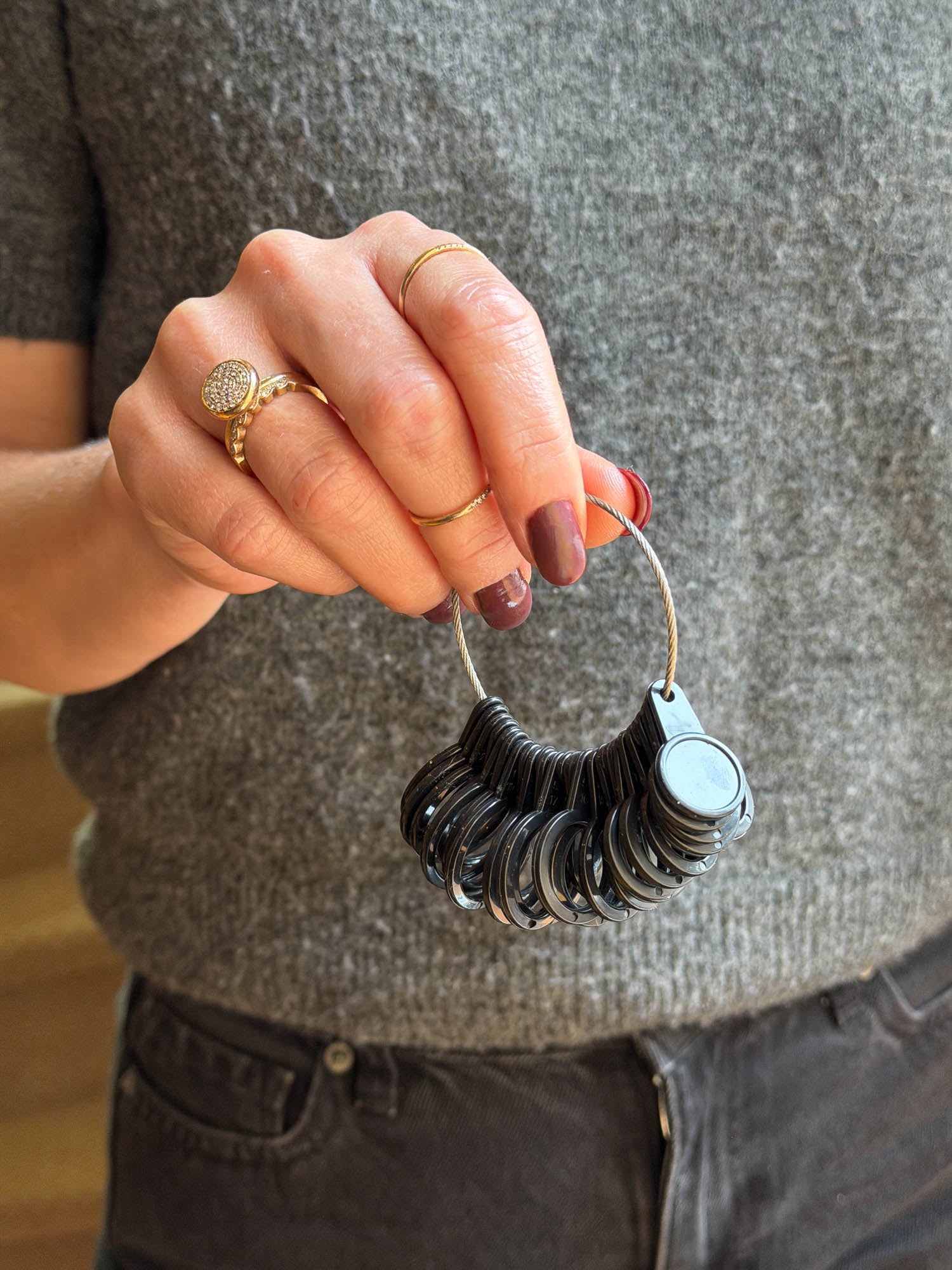
The ring sizer
A simple sizer you try at home, at your own pace. Test it at different times of day over a few days, and you get a size that matches everyday life — not just a single moment.
Frequently asked questions
Questions about ring size
Which size should I choose if I'm between two?
Choose the smaller one. It is easier to make a ring larger than smaller, and a ring that sits a little snugly usually feels right as the finger changes through the day.
Does the width of the ring matter?
Yes. Wide rings, from roughly 4–6 mm upwards, feel tighter on the finger. Expect to go up half a size. Slim rings usually fit well in the exact size.
What time of day should I measure?
In the afternoon or evening, when your fingers are at their normal size. Avoid measuring early in the morning, straight after exercise, or when you are cold.
How do I measure a ring I already have?
Measure the inner diameter in millimetres across the ring, at its widest point. Then compare it with the size chart on this page, which lists both diameter (D) and circumference (O). Measure twice if you can — a few tenths make a difference.
How do I find out the size without giving myself away?
Borrow a ring the person wears on the right finger and measure the inner diameter, or bring it to us in the store and we'll measure it for you. Another way is to ask someone close to them who already knows.
Can the size be altered afterwards?
Usually yes. It depends on the model, the material and any engraving or stone setting. Get in touch and we'll look at your particular ring and tell you what's possible.
Not sure? We'll help you
Book an appointment at the store at Sankt Hansgatan 26 in Visby and we'll find the size together, without rushing. If you prefer to measure at home, we'll help you remotely.